Home › History ›Early Sandwich ›When Settlers Told Their Story

“In the month of June, 1851, just 46 years ago, I left a temporary home in Troy, New York… With no certain point of destination in view, but fully determined to make for myself a home somewhere in the Great West…”
With these words, Judge Stephen B. Stinson began a recollection that carried listeners from the canals and lakes of the East to the open prairie of northern Illinois, when Sandwich existed more as possibility than certainty, and the scattered claims of settlers were only beginning to form a community.
In the later years of the 19th century, the earliest settlers of the Sandwich area gathered at the Fair Grounds to reflect on a past that, even then, already felt distant. They spoke not only of progress, but of hardship, uncertainty, and the long journey that brought them west.
Among the most valuable recollections preserved from that gathering is an address delivered by Judge Stephen B. Stinson, a pioneer resident and early civic leader. His words offer a rare and detailed account of the settlement of what would become Sandwich and Somonauk Township.
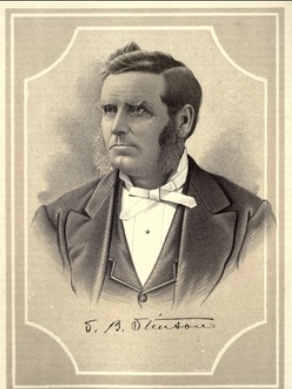
The Journey West
Stinson’s story begins not in Illinois, but in the East. In June of 1851, he left his home in Troy, New York, setting out with no fixed destination, only the determination to make a life somewhere in the growing West.
His journey followed the great transportation routes of the time: the Erie Canal, the Great Lakes, and finally to Chicago, a city that, even then, hinted at its future importance.
“When the first village plat was made… the name ‘Almon’ was given to the embryo village… but in the meantime… the name of Sandwich had been given… and the county records show the deed thus at the present time.”
When Sandwich Was Still Finding Its Identity
When Stinson arrived in the region, the community that would become Sandwich was still taking shape.
Although the name Sandwich was already in use through the local post office by 1850, the settlement itself had not yet fully emerged as the dominant center of activity in the area. Nearby Newark remained larger and more established, and early village efforts developed unevenly across the region.
One such effort centered near present-day Somonauk, where a settlement briefly took shape under the name “Almon,” in honor of early landowner Almon Gage. Delays in recording the plat, along with shifting patterns of development and transportation, eventually led to the abandonment of that name.
As settlement increased and the railroad transformed the region, the name Sandwich gradually became more firmly attached to the growing community. As Stinson recalled, the choice reflected both familiarity and practicality in a rapidly developing frontier.
The Railroad Changes Everything
Like so many Midwestern towns, Sandwich owes much of its early growth to the railroad.
By 1853, construction had begun on the extension of the line west from Aurora. Within a short time, the railroad reached the area near Big Rock Creek, opening the region to broader markets and opportunity.
Stinson himself took part in this transformation, shipping grain to Chicago and benefiting from the new access the railroad provided. The arrival of the line did not simply connect Sandwich to the outside world, it helped create the town itself.
Newark Station and the Struggle for Identity
As Judge Stephen B. Stinson recalled, early railroad activity in the region did not center on Sandwich at all.
The original flag stop, though located at what would become Sandwich, was known as Newark Station, reflecting the fact that Newark was, at the time, the larger and more established community. Business and identity were tied not to location, but to prominence.
But the people of Sandwich were not content to remain, as Stinson put it, “the tail to Newark’s kite.”
As local demand grew, and as Sandwich began to assert itself, efforts were made to secure recognition in its own right. The railroad did not relocate the stop, the station remained in the same place, but its identity gradually shifted. What had been known as Newark Station became, in time, a station for Sandwich.
This change marked more than a simple renaming. It reflected a turning point, when Sandwich moved from being overshadowed by a neighboring town to defining its own future.
First Settlers and Early Claims
Stinson’s recollections preserve the names of those who first claimed and worked the land:
- Reuben Root, among the earliest settlers in the area
- Captain William Davis, whose claim became a focal point of early settlement
- George Beveridge, whose farm would later gain quiet historical significance
- Families such as the Harmons, Lathams, and others who shaped the township
These were not simply names, but individuals who endured isolation, uncertainty, and the demands of frontier life.
Life on the Prairie
The early years were marked by hardship.
Cabins were simple, illness was common, and resources were scarce. Settlers often lived far from one another, yet depended on cooperation to survive. Money was limited, and many were forced to borrow at high rates or rely on the support of neighbors.
And yet, from these conditions grew a community, one built as much on resilience as on opportunity.
A Quiet Role in a Larger Story
One of the most remarkable details preserved in Stinson’s account is the role of the Beveridge farm, located near Somonauk Creek.
According to his recollection, the farm served as a stop on the Underground Railroad, offering shelter to freedom seekers traveling north. Though quietly carried out, such acts placed this small settlement within the broader national story of slavery and freedom.
The First Institutions
As settlement took hold, the foundations of community life began to emerge:
- A post office was established under the name Somonauk
- The first schools were built of logs and served small groups of students
- Religious services were held in homes before churches were constructed
- Tradesmen, including blacksmiths and merchants, began to establish themselves
These early institutions marked the transition from scattered settlement to organized community.
Looking Back
By the time Stinson delivered his address, Sandwich had grown into a thriving town, far removed from the uncertain prairie he first encountered in 1851.
Yet his recollections serve as a reminder that the town’s foundations were laid not only in ambition, but in perseverance. The settlers he described did more than claim land, they built a community that would endure.
Sources
Old Settlers Meet address, Judge Stephen B. Stinson
Family materials and local records, Truman Crowell